
BLOOD FLOW RESTRICTION TRAINING
Blood Flow Restriction Physical Therapy in Raleigh
Blood Flow Restriction training uses a specialized cuff and low-load exercise to help improve strength and muscle capacity when heavier resistance is not yet appropriate or well tolerated.
UNDERSTANDING BFR
What Is Blood Flow Restriction Training?
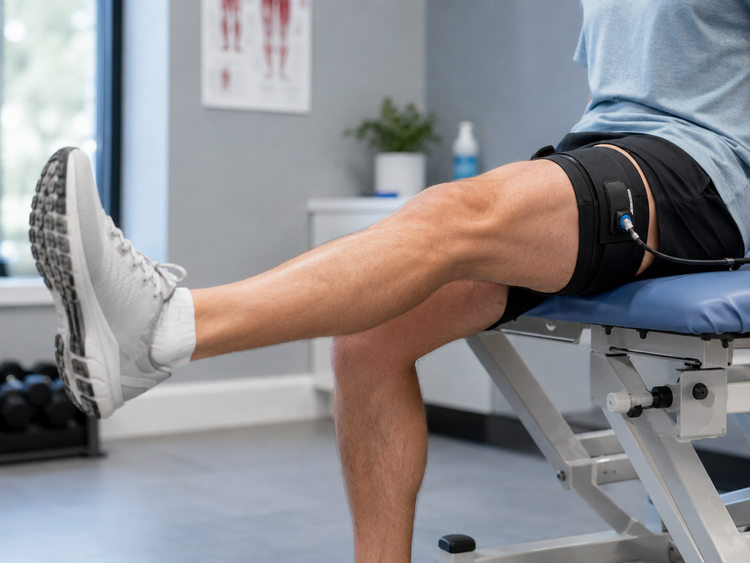
Blood Flow Restriction training uses a specialized pneumatic cuff placed around the upper portion of an arm or leg during low-load exercise.
The cuff partially limits venous blood flow leaving the limb while maintaining arterial blood flow into the working muscles. This creates a challenging muscular environment even though the external resistance remains relatively light.
BFR can be useful when pain, surgery, tissue healing, or joint sensitivity makes traditional heavy resistance training difficult.
The goal is not to avoid heavier exercise forever. BFR is often used as a bridge toward more traditional strength training.
POTENTIAL BENEFITS
Why Blood Flow Restriction May Help
BFR allows muscles to experience a meaningful training stimulus while using relatively light external resistance.
Build Strength With Lighter Loads
Useful when joints or healing tissues are not ready for heavier resistance.
Limit Muscle Loss
May help preserve or rebuild muscle during periods of reduced activity.
Support Earlier Loading
Provides an option for meaningful exercise during earlier stages of rehabilitation.
Improve Exercise Tolerance
Low-load strengthening can provide a strong challenge even when higher-load training is not yet tolerated well.
COMMON REHABILITATION USES
When BFR May Be Helpful in Physical Therapy
BFR can be considered when building strength is important but heavier loading is limited by pain, post-operative restrictions, or current tissue tolerance.
Post-operative rehabilitation
Useful when restoring muscle capacity after surgery while external loads still need to remain lighter.
Joint pain or irritability
Helpful when traditional heavy resistance aggravates symptoms and a lower-load option is needed.
Muscle atrophy or weakness
May help address visible or measurable muscle loss during recovery.
Return to strength training
Can serve as a bridge while progressing toward heavier traditional strengthening.
WHAT TO EXPECT
What a BFR Session Typically Looks Like
A session begins with screening and determining whether BFR is appropriate for you based on your health history, current condition, and goals.
A cuff is then placed on the upper arm or upper leg depending on the exercise being performed. Pressure is selected individually rather than guessed.
Exercises are usually performed using lighter resistance and higher repetitions with brief rest periods. The work should feel challenging, but it should remain controlled and monitored.
Your response to BFR helps determine how it fits within the larger rehabilitation program.
COMMON EXPERIENCE DURING BFR
What BFR Usually Feels Like
The cuff pressure and repeated muscular effort often create a strong burning or fatigue sensation in the working muscles, even with lighter loads.
Fatigue Builds Quickly
Muscles often feel tired faster than expected because the exercise environment is intentionally more demanding.
A Pressure Sensation Is Expected
The cuff should feel snug and purposeful, not random or sloppy.
Burning Does Not Mean Harm
Muscular fatigue is common during the set and is part of the training effect when used appropriately.
Monitoring Matters
Your therapist should watch how you respond and adjust as needed.
The goal is a challenging, controlled muscular response—not uncontrolled pain, numbness, or a concerning reaction.
SCREENING AND SAFETY
BFR Requires Appropriate Screening
BFR is not automatically appropriate for every patient. Health history, medications, vascular considerations, and the current condition must be reviewed before using it.
Clinical screening comes first
We review your relevant health history, injury, surgery, and rehab goals before deciding whether BFR is appropriate.
Pressure should be individualized
Proper application matters. BFR should not be treated as a generic “tight strap” exercise.
Monitoring matters during exercise
Symptoms, limb response, fatigue, and exercise tolerance should be observed during the session.
BFR is one tool, not the whole program
It may support recovery, but it should be integrated into a broader treatment plan based on your goals and condition.
WHO MAY BENEFIT
Who May Be a Good Fit for BFR
BFR can be considered across a variety of orthopedic and sports-related presentations when clinically appropriate.
Post-surgical patients
Especially when rebuilding strength is important but load tolerance is still limited.
People with knee pain
Useful when traditional strengthening loads are not well tolerated.
Athletes rebuilding capacity
Can help during phases when training stress must be modified but progress still matters.
Patients with muscle weakness or atrophy
May support rebuilding muscle capacity when loading options are temporarily limited.
YOUR FIRST VISIT
How We Decide If BFR Fits Your Plan
Your first appointment includes a one-on-one evaluation with a Doctor of Physical Therapy. We review your symptoms, goals, relevant health history, current strength limitations, and the type of exercise your recovery requires.
If BFR appears appropriate, it may be introduced as part of your treatment plan once screening and exercise selection support its use.
FREQUENTLY ASKED QUESTIONS
Blood Flow Restriction FAQs
Is BFR supposed to feel hard even with light weight?
Yes. One of the reasons BFR is used is that it can create a significant muscular challenge while keeping the external load relatively light.
Does BFR replace regular strength training?
No. It is often used as a temporary tool or supplement within a broader strengthening plan.
Is the cuff just tightened as much as possible?
No. Pressure should be selected purposefully and individually rather than guessed.
Can BFR help after surgery?
It may be helpful in some post-operative situations when strength recovery is needed but heavy loading is not yet appropriate.
Will BFR be the only thing I do in therapy?
No. It is just one part of rehabilitation and is usually combined with mobility work, strengthening, education, and progressive activity.
How do you decide whether I’m a good fit?
We look at your condition, goals, current limitations, health history, and whether BFR makes sense clinically within your rehab plan.